Reliability as a factor for success
Quality management is rarely in the spotlight. It simply has an impact quietly in the background when processes work well, standards are set out clearly and all employees aspire to implement them consistently. Reliability becomes a clear competitive advantage.
Leonid Butschbach and Marco Heine are rarely right at the front. In a motorsport team, they would be the race engineers, acting as the interface between the driver and the team. While Leonid Butschbach, in his role as quality management officer, focuses primarily on operational implementation, Marco Heine’s role as the responsible division manager means he makes sure that the general conditions are right. Or as he puts it himself: “I clear the obstacles out of the way to allow Leo to do his work.” They work together to monitor the processes, analyse data and identify any deviations. This is how they ensure that reliability becomes a real selling point. “Customers trust companies when they know they can rely on consistent quality. This trust is an important factor in being successful,” they agree. At the same time, they are aware that reliability and the trust that results from this can only be achieved if quality is firmly established in a process right from the outset. The management that goes into this should ideally remain in the background.
A quality culture as part of the DNA
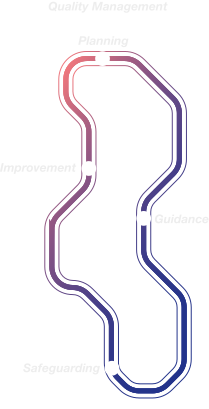
Quality planning, control, assurance and improvement – this four-stage model defines the guidelines for quality management. Requirements are clearly defined, stable processes are guaranteed, test plans and standards provide certainty and at the end there is a continuous improvement process. What matters is that this quality culture is embraced within the company. Marco Heine explains: “The crucial factor for us is how quickly problems are identified, communicated and solved. This is the basis for a good quality culture in which you learn from any errors. Dealing with any deviations swiftly and professionally is therefore a top priority.” ’You learn from your errors’ is not just an empty phrase, but something that happens in practice every single day.
The best performance is not the most spectacular, but the one that can be reliably delivered at any time.
Analysis meets experience
The blend of reliable measuring systems and the experience of the employees is very important. While data will provide objective facts, it is people who will categorise and interpret this data. The combination of the two allows well-informed decisions to be made. “Quality is only created when all divisions work together. It is a team effort throughout the whole value chain. ’Raw material’ as a factor cannot be underestimated either. At the same time, key indicators like the number of complaints, recurring errors or customer reviews are important because they enable us to keep improving continuously,” says Leonid Butschbach. On the other hand, a lack of transparency, confused handovers or unstable processes are counterproductive.
Vision for the future
Reliability and trust are emotions based on facts and experiences. This is true for both employees and customers. The employees at the plants find that clear specifications make their daily lives at work easier. Communication, involvement and transparency create an awareness of quality and trust in the process. With this in mind, challenges for the future can also be met. “Of course we’re addressing stricter regulatory requirements, the use of AI in some areas and the growing importance of sustainability,” says Leonid Butschbach. For Marco Heine, what really matters is that customers always feel that we’re looking after them. “How do we communicate if something happens? How do we solve problems and how quickly do we do this? Our customers are interested in the overall outcome: stable processes, promises that are kept and professional handling of any deviations. Quality management ensures that these factors all come together. This shapes the perception of our performance in the market and forms the basis for satisfaction, repeat business and long-term economic success.”
Maybe this is where we see the real difference compared to motorsport: whereas every lap driven around a race track entails maximum risk, at Progroup it’s all about ensuring that risks don’t emerge in the first place. The best performance isn’t the most spectacular, but the one that can be repeated reliably again and again. If everything runs smoothly, everyone involved knows exactly what they need to do and when they need to do it, and quality is delivered as a matter of course, the “race engineers” have done their job perfectly. Long before the chequered flag is waved.